Bitcoin analysis sets $60,000–$80,000 range but leaves timing unclear
 Phuong-Linh Nguyen
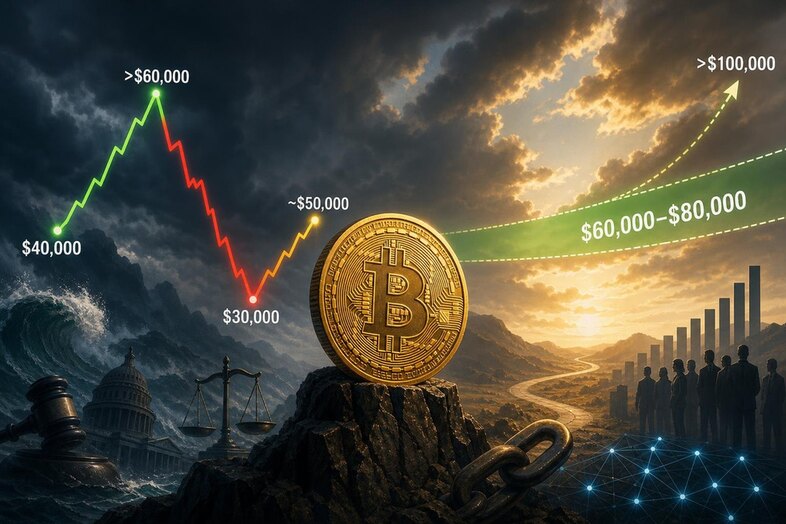
A Bitcoin analysis published on 18 July 2024 describes a climb from about $40,000 to above $60,000, a subsequent fall into the $30,000 range and a recovery towards $50,000. It then projects a possible range of $60,000 to $80,000, with a chance of topping $100,000, but gives no dates or method for those estimates.
The figures are in US dollars. The account does not specify when during the year Bitcoin reached each level, or provide a source for the prices. Its description of Bitcoin “approaching the end of the year” while hovering near $50,000 also sits awkwardly with the article’s 18 July publication date. That makes the chronology difficult to assess from the text alone.
A volatile path, without a detailed timeline
The analysis presents the move between roughly $40,000, more than $60,000, the $30,000 range and about $50,000 as evidence of Bitcoin’s resilience. For traders and investors, the same sequence also shows the scale of the swings described: the price did not move steadily towards the forecast range. The article offers no daily or monthly prices, so it is not possible to establish from its figures how long Bitcoin spent at each level or how quickly it moved between them.
That distinction matters when considering the prediction. A broad price range does not tell readers when the lower or upper end might be reached, and the article does not set out assumptions that could be used to test its forecast. It calls exact price predictions speculative, then gives a potential $60,000–$80,000 range and says Bitcoin could exceed $100,000 on what it calls current growth trajectories. No specific trajectory, measurement period or calculation accompanies that claim.

Demand, regulation and technology
The article identifies investor interest, wider acceptance and institutional investment as factors that can affect demand. It argues that rising mainstream acceptance and institutional participation have strengthened Bitcoin’s profile. It does not name investors or institutions, quantify their activity or give figures for adoption, leaving those points as broad explanations rather than evidence that can be compared with the price movements it describes.
Regulation is another factor in its account. The analysis says government policy can have an immediate effect on Bitcoin’s price, with favourable news potentially supporting gains and crackdowns contributing to sharp falls. It expects tighter rules to create a clearer framework and encourage more institutional investment, but does not identify a jurisdiction, a proposed rule or a timetable. Readers therefore get no concrete regulatory event against which to judge that expectation.
On the technology side, the article points to network upgrades and scalability improvements, and names the Lightning Network as a development that it says can speed up transactions and lower costs. It also argues that greater use in everyday transactions and financial systems could increase utility. The text supplies no usage or cost figures, and does not describe a particular integration. These are presented as possible supports for Bitcoin’s value, not as quantified contributions to the price forecast.

Investment case and practical limits
The analysis links Bitcoin’s limited supply to its potential role as a hedge against currency devaluation during inflation. It also cites possible use in decentralised finance, saying that integration with DeFi platforms could add utility and demand. Neither case is accompanied by figures on supply, inflation, platform activity or investment flows. The article consequently does not establish how much either factor has influenced the price levels it reports.
For market readers, the practical takeaway is a set of scenarios rather than a dated price target. The analysis sees a route from about $50,000 towards $60,000–$80,000 and leaves open a move above $100,000, while acknowledging that exact forecasts are speculative. Its account does not quantify the risk of another fall, estimate the probability of any target or provide a timeframe. The price levels it cites remain in US dollars, with the latest level in its narrative around $50,000.