Braiins warns Bitcoin miners after attacks hit more than 1,000 sites
 Phuong-Linh Nguyen

Bitcoin mining pool operator Braiins has identified 24 attacks that redirected traffic between miners and their pools, allowing attackers to claim credit for work performed by other machines. The incidents, recorded from 7 to 20 November, affected more than 1,000 mining sites, according to the company.
Braiins said the computing power caught up in a single attack grew almost elevenfold over the two-week period. The affected hashrate rose from below 175 petahashes per second (PH/s) to 1.9 exahashes per second (EH/s), the company reported.
Bitcoin’s total hashrate was estimated at 1,016 EH/s on 20 November, according to MineOrNot data cited by Braiins. The largest attack therefore involved computing power equivalent to about 0.19% of the network total. That figure describes the scale of the affected mining capacity, not a loss of the same proportion of Bitcoin’s overall hashrate.

Miners may keep paying for power as rewards are diverted
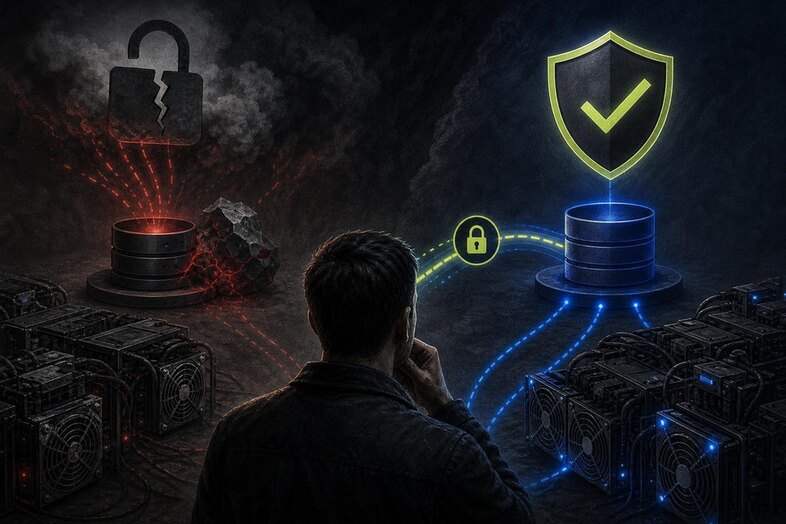
The attacks exploited Stratum V1, a widely used protocol introduced in 2012 for communication between mining machines and pools. In its unsecured form, it does not let miners confirm that they have connected to the pool they intended to use. An attacker can impersonate a pool and redirect the traffic, then claim Bitcoin (BTC) rewards generated by the miners’ work.
Machines can continue running during an attack, Braiins said, so operators may not immediately realise that their mining income is being diverted. They could still incur electricity costs while receiving fewer or no rewards for the work being carried out.
Earlier incidents mainly affected mining sites in Brazil and Argentina. Four larger attacks on 20 November each involved between 1,050 and 1,600 sites, mostly in Europe. Braiins did not say whether those locations belonged to large commercial farms or independent miners, nor did it estimate how much BTC or money may have been lost.
The company said neither its own pool nor the affected machines had been directly hacked. The issue instead lies in the way miners’ connections can be redirected when they use unsecured Stratum V1 links. Braiins also warned that most Bitcoin hashrate still relies on unsecured Stratum V1 connections, leaving the exposure broader than the sites identified in these incidents.
Braiins recommends encrypted connections
On 23 November, Braiins reviewed the largest Bitcoin mining pools and found that most still offered only unsecured Stratum V1 connections. It urged miners to move to Stratum V2, a newer version that protects communications and lets miners verify they are connected to the correct pool.
Operators unable to upgrade can continue using Stratum V1 if their pool offers an encrypted connection and their mining software can verify the pool’s identity. The practical choice is therefore not limited to replacing mining equipment: connection security and pool verification also matter.
The warning comes as miners face lower Bitcoin prices and high operating costs. Several large mining companies are moving into artificial intelligence and data centre services to seek additional revenue. For miners continuing to rely on BTC rewards, diverted work could add to pressure on returns while electricity bills continue.
Braiins’ report follows a separate incident involving mining services provider Luxor Technology earlier in November. Attackers exploited a vulnerability in its Commander mining-management software to redirect customer hashrate to the OCEAN mining pool, affecting slightly more than a dozen accounts. Luxor said it fixed the problem within two hours of discovering the unauthorised changes and promised to compensate affected customers in full.
Braiins has not disclosed losses from its 24 reported incidents. Its review found that most of the largest pools it checked on 23 November still offered only unsecured Stratum V1 connections.