Solihull crypto robbery highlights growing threat of violent attacks on holders
 Phuong-Linh Nguyen
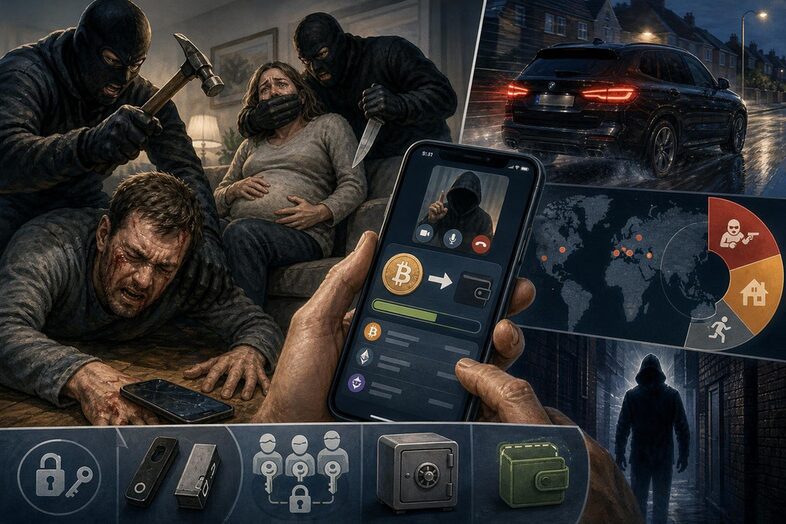
A Solihull couple were forced to transfer cryptocurrency after three masked men beat the husband with hammers and threatened his pregnant wife with a knife in their home, in a robbery that illustrates how crypto holders can be targeted through physical coercion rather than a digital breach.
The attack took place at about 5.20pm on 13 December 2025, when the couple returned to their home in Smith’s Wood, West Midlands. The husband, referred to as “James” by the BBC, is an amateur cryptocurrency trader. He said he tried to resist the intruders, who struck him repeatedly in the face, head and ribs. His wife, then seven months pregnant with the couple’s third child, was held on a sofa and threatened with a knife.
James told the BBC that a fourth person joined by FaceTime and guided the men through the process of moving the funds. The attackers apparently did not know how to access the crypto themselves. They were told which apps to open on his phone and which wallet held the assets.
The ordeal lasted around 45 minutes. The gang left with the transferred cryptocurrency and several Rolex watches, reportedly travelling in a black BMW X3. West Midlands Police is investigating the case.
Police appeal follows months after attack
Crimestoppers announced a £10,000 reward for information on 24 September 2026, more than nine months after the robbery. It described the four suspects as being in their twenties. One was identified in the appeal as a Black man with a small diagonal scar beneath his left eyebrow.
The case falls into a category security researchers call a “wrench attack”: criminals use violence or threats to make a victim unlock a device or authorise a transaction. In a self-custody arrangement, a holder controls access to their funds, but that also means an attacker may try to force the person to use their phone or wallet. Encryption cannot prevent someone being threatened in person.
In Solihull, the attackers’ reliance on a remote guide shows that a gang need not have detailed technical knowledge if it can control the victim and get instructions from someone else. The transfer was carried out through the victim’s phone, while the person on the call directed the process.

Reported attacks and losses
A joint report by blockchain analytics firm TRM Labs and London’s Metropolitan Police recorded 17 reported wrench attacks in London between March and December 2024. Kidnapping accounted for 59% of the cases, aggravated burglary for 35% and robbery for 6%. The average loss was about $880,000 per incident.
CertiK reported 52 verified wrench attacks globally in the first half of 2026, with recorded exposure of $124.1 million. Home invasions made up 20 cases, or about 41% of the total, compared with one publicly reported case in the same period a year earlier, according to the firm.
Chainalysis separately estimated that violent crypto robberies had taken about $30 million, roughly £22.6 million, by June 2026. It said 2026 could become the worst year on record for the crime and that home invasions were increasing. The figures cover different reporting sets and should not be treated as a single tally.
Earlier British cases include a 2018 armed break-in at the Oxfordshire home of trader Danny Aston, where four men tied up his partner and forced him at gunpoint to transfer Bitcoin. In 2021, a Canterbury Christ Church University student was held at knifepoint by eight men and made to hand over £6,000 in Bitcoin and a £3,000 student loan. A group of teenagers also stole more than £115,000 in digital assets in a series of London robberies between 2021 and 2022.
Practical risks for self-custody
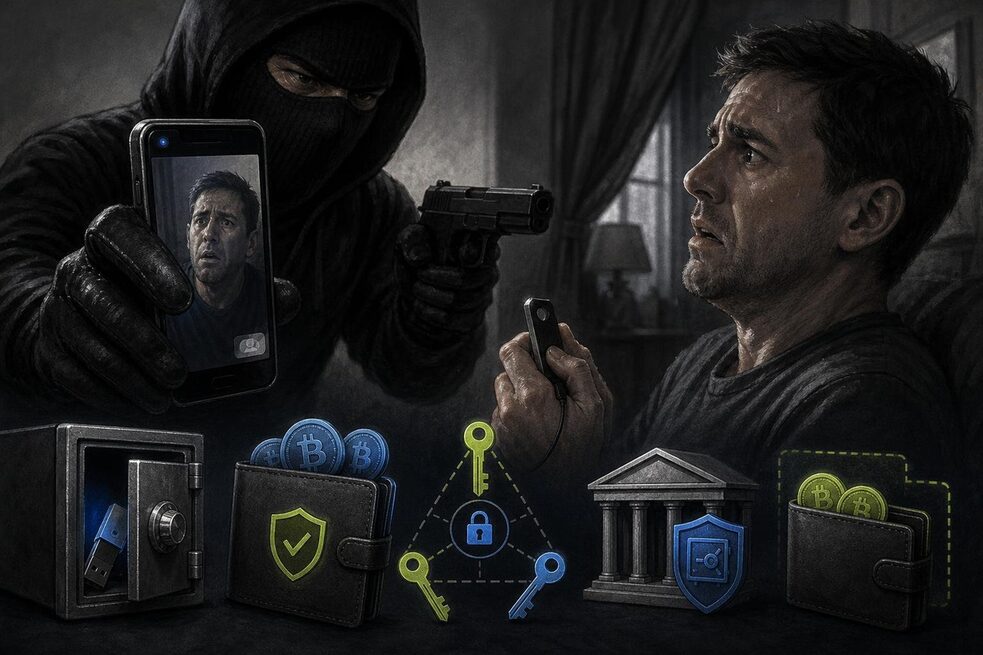
The available figures describe crime and losses, not movements in crypto prices. They do, however, show why the security of a wallet cannot be considered only in terms of software or key management. In the Solihull robbery, the vulnerability was the holder’s physical exposure, and the attackers used a live video call to bridge the gap between violence and the technical steps needed to make a transfer.
Security advice cited in the source material includes keeping information about holdings private, avoiding a single wallet that one person can be forced to unlock, and considering cold storage, multi-signature arrangements or custodial accounts. Some holders also use decoy wallets with limited balances. These measures do not remove the risk of assault, and personal safety remains the immediate priority during a threat.
Anyone with information about the Solihull attack can contact Crimestoppers anonymously on 0800 555 111. The reward announced for information is £10,000.