UK crypto signals point to institutional growth, but retail rules tighten
 Phuong-Linh Nguyen

UK banks are testing blockchain-based settlement while the Financial Conduct Authority’s new digital asset licensing regime restricts yield-bearing products for retail customers, according to the material supplied. The contrast points to two different developments: financial firms are exploring tokenised transactions, while access to some crypto services for individuals is becoming more constrained.
The source cites a Lloyds Banking Group survey in which 71% of senior UK financial decision-makers said they expect tokenisation to transform traditional transactions within the next decade. It also describes a Lloyds and Visa pilot that settled $750,000 in USDC in less than an hour. Those figures indicate institutional interest in blockchain settlement, but the source gives no evidence that the trial has changed the way consumers buy or transfer crypto.
The distinction matters for investors. The pilot involved a settlement test between organisations; it is not presented as a service available to ordinary account holders. Lloyds and Barclays are also described as testing tokenised deposits for interbank settlement. The source says those arrangements are separate from public cryptocurrency networks, so their development should not be read as direct evidence of wider retail access to crypto.

Licensing brings limits for retail services
The FCA’s digital asset licensing gateway opened on 30 September 2026, according to the source. Its rules prohibit yield-bearing products and passive interest programmes. For customers using registered UK platforms, that means such services will not be available under the regime described. The source contrasts this with offshore platforms, but offers no figures on how many investors use either type of provider or on the difference in returns.
There are no prices, trading volumes or asset-by-asset performance figures in the material. It therefore does not establish whether Bitcoin, Ethereum, Solana or other cryptocurrencies rose or fell, nor does it quantify any effect on market demand. The reported changes concern the infrastructure and rules around crypto, rather than a measured move in token prices.
For customers, the practical issue is the type of service they can access, not a stated change in the price of an asset. Someone looking for interest on crypto holdings would need to distinguish between a UK platform operating under the new regime and an offshore provider. The source does not set out the protections available from offshore firms, so it cannot support a comparison of their safety or terms.
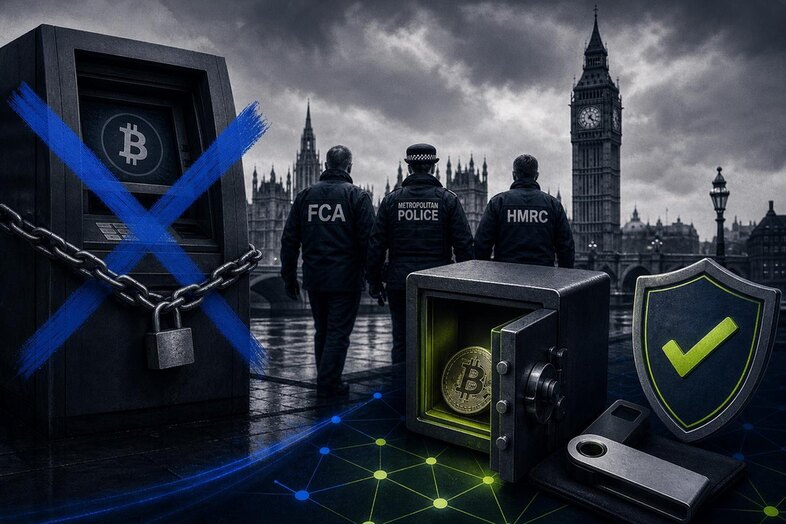
Enforcement narrows access to cash-to-crypto services
The account also reports joint enforcement operations by the FCA, the Metropolitan Police and HMRC against unregistered cash-to-crypto portals in London. It says those operations reduced the number of legally operating crypto ATMs in the UK to zero. That is a specific claim about ATM availability; the material does not give a date for the raids or provide a breakdown of the businesses affected.
The reported enforcement action and licensing rules shape different parts of the retail experience. The ATM figure concerns cash access, while the ban on yield-bearing products concerns what customers can earn through registered platforms. Neither detail shows how much money has moved into or out of crypto, or whether UK investors have changed their holdings as a result.
The source advises investors to focus on custody, cold storage and regulated fund structures rather than high-yield staking portals. It also recommends verified hardware wallets and licensed providers for retail users. These are presented as practical precautions, not as a guarantee against loss. The material provides no comparison of custody costs, fund performance or wallet security, so those options cannot be ranked from the details supplied.
The clearest market measures in the account are therefore operational: a reported $750,000 USDC settlement pilot completed in under an hour, a licensing gateway opened on 30 September 2026, and no legally operating crypto ATMs remaining in the UK after the cited enforcement sweeps. It supplies no current crypto prices with which to measure a corresponding change in the market.